
.


ClairAudient Bellare Specifications
The Audience ClairAudient Bellare is available in two configurations: Monopole and Bi-pole. Both versions share the same internally powered bass system and TimeWave driver technology. The Bi-pole adds two rear-firing TimeWave 3 wideband drivers, operating in phase with the front drivers, for increased sensitivity, dynamic capability, and a more expansive sound field.
System Configuration
System Type:
Floor standing, sealed-enclosure loudspeaker system with externally powered wideband drivers and internally powered DSP-controlled bass system
Available Configurations:
Monopole and Bi-pole
Monopole
- Two front-firing Audience TimeWave 3 (TW3) 3-inch wideband drivers per loudspeaker
- Nominal impedance: 8 ohms
- Sensitivity: 86 dB (1 W/1 m)
Bi-pole
- Two front-firing and two rear-firing Audience TimeWave 3 (TW3) 3-inch wideband drivers per loudspeaker
- Front and rear TW3 drivers operate in phase
- Nominal impedance: 4 ohms
- Sensitivity: 88 dB (1 W/1 m)
Driver Complement
Wideband Drivers:
Audience TimeWave 3 (TW3), 3-inch wideband drivers
Mid-woofer:
Audience TimeWave 7 (TW7), 7-inch high-excursion driver
Woofer:
10-inch high-excursion woofer
Frequency Response
System Frequency Response:
18 Hz–22 kHz, ±3 dB, with ARC calibration
TW3 High-Frequency Extension:
Approximately 42 kHz
Crossover and Bass System
Wideband/Bass Transition:
Approximately 140 Hz nominal
TW3 High-Pass Network:
Passive second-order high-pass network using a high-quality air-core inductor and Auricap XO-PUR-CT capacitors
Bass Low-Pass:
Active DSP-controlled adjustable low-pass filtering
Internal Bass Amplification:
300-watt Class D DSP amplifier in each loudspeaker
Room Correction:
Automatic Room Correction (ARC), individually calibrated for each loudspeaker using the supplied measurement microphone
Bass Level and Phase:
User adjustable
Amplifier Requirements
Bellare requires an external stereo power amplifier or pair of monaural amplifiers to drive the TimeWave 3 wideband driver array.
As a general recommendation, a high-quality amplifier capable of at least 30 watts continuous output will work very well with Bellare. Depending upon amplifier quality, however, excellent results may be obtained with as little as:
Bi-pole: 10 watts into 4 ohms
Monopole: 20 watts into 8 ohms
Higher-output amplifiers are also fully compatible.
Bellare's internally powered bass architecture substantially reduces the low-frequency workload placed on the external amplifier. Below approximately 140 Hz, the external amplifier sees a rising impedance, while Bellare's internal 300-watt DSP amplifier supplies the power required by the bass system. This allows Bellare to be successfully partnered with a particularly wide range of high-quality amplification.
Dimensions and Weight
Dimensions:
46" H × 9.5" W × 18" D
Weight:
Approximately 100 lb per loudspeaker
Construction
Enclosure:
Internally braced and compartmentalized sealed cabinet
Isolation:
Stillpoints Ultra 1S isolation footers
Internal Wiring:
Audience OHNO wire
Crossover Components:
Premium Audience-selected components including Auricap XO-PUR-CT capacitors and air-core inductors
Pricing
ClairAudient Bellare Monopole:
$36,000 per pair
ClairAudient Bellare Bi-pole:
$39,000 per pair
ClairAudient Bellare Features
Bellare brings together Audience's wideband-driver philosophy, full-range bass performance, room integration, and unusually flexible amplifier compatibility in a loudspeaker designed around one overriding objective: preserving the integrity of the musical signal.
Wideband Coherence Without Sacrificing Full-Range Performance
At the heart of Bellare are Audience's proprietary 3-inch TimeWave 3 (TW3) wideband drivers.
From 140 Hz upward, the TW3 drivers reproduce virtually the entire musically critical range without the conventional transition from a midrange driver to a tweeter.
This greatly reduces the frequency-dependent changes in driver character, phase behavior, dispersion, and timing that can occur through conventional multiway crossover regions.
The result is one of Bellare's defining qualities: exceptional musical continuity and coherence from the fundamental tones of voices and instruments through their upper harmonics.
And unlike traditional wideband or single-driver loudspeakers, Bellare does not require sacrificing deep bass, dynamic capability, or realistic musical scale to achieve that coherence.
No Conventional Midrange-to-Tweeter Crossover
Most multiway loudspeakers divide the musical spectrum among different types and sizes of drivers, requiring a crossover in the critical midrange and lower-treble region.
Bellare takes a fundamentally different approach.
The same TW3 wideband driver technology reproduces the spectrum from approximately 140 Hz through and beyond the audible high-frequency range. There is therefore no conventional midrange-to-tweeter crossover or handoff through the frequencies to which human hearing is particularly sensitive.
Voices and instruments remain substantially within the same driver system rather than being divided between dissimilar midrange and high-frequency drivers.
Audience TimeWave Driver Technology
Bellare represents the latest evolution of Audience's decades-long development of wideband loudspeaker drivers.
The TimeWave 3 incorporates a lightweight composite aluminum diaphragm, powerful neodymium magnet structure, Audience's MMAG dual-gap motor technology, high-excursion suspension, and a low-mass voice-coil system designed to combine speed, bandwidth, dynamic capability, and exceptionally low stored energy.
The companion 7-inch TimeWave 7 mid-woofer uses the same Audience driver technology to provide a natural transition between the TW3 wideband array and Bellare's deep-bass system.
Internally Powered Bass
Bellare separates two very different loudspeaker demands.
The TW3 wideband array handles the frequencies where coherence, timing, tonal character, and spatial information are especially important.
The demanding work of reproducing deep bass is handled by a dedicated 7-inch TimeWave 7 mid-woofer and 10-inch high-excursion woofer, powered by an internal 300-watt DSP amplifier in each loudspeaker.
This architecture allows the wideband drivers to operate without the large excursions required for deep bass while providing the power and displacement necessary for genuine full-range reproduction.
Automatic Room Correction
At low frequencies, the listening room becomes an integral part of what you hear.
Bellare incorporates Automatic Room Correction (ARC) to optimize the bass system for the acoustic characteristics of the individual listening environment.
Using the supplied calibrated microphone, each Bellare is measured and calibrated independently. The resulting correction is stored within each loudspeaker's DSP system.
ARC allows Bellare's deep-bass capability to be integrated with the room rather than simply imposed upon it.
Easy to Drive, Endlessly Pairable
Bellare is exceptionally amplifier friendly.
Because Bellare's internal 300-watt amplifier supplies the power required by the bass system, the listener's external amplifier is relieved of much of the demanding low-frequency workload encountered with conventional full-range passive loudspeakers.
This makes Bellare compatible with an unusually broad range of high-quality amplification, including many lower-powered tube and solid-state designs.
The result is greater freedom to choose an amplifier for its musical qualities rather than simply for its ability to deliver large amounts of low-frequency power.
Monopole or Bi-pole
Bellare is available in two configurations to accommodate different rooms, placement requirements, and listening preferences.
The Monopole uses two front-firing TW3 wideband drivers per loudspeaker and is particularly well suited to smaller rooms or installations where the loudspeakers must be positioned closer to the front wall.
The Bi-pole adds two rear-firing TW3 drivers operating in phase with the front pair. In rooms where the loudspeakers can be positioned farther from the front wall, the additional rear radiation contributes to increased sensitivity, dynamic capability, and a larger, more immersive sound field.
Both versions retain the same fundamental Bellare design philosophy and internally powered bass system.
A SweetSpace, Not Just a Sweet Spot
High-performance loudspeakers are often associated with a narrowly defined listening position where imaging and tonal balance are at their best.
Bellare was designed to create something more expansive.
Its wideband architecture and uniform polar behavior help maintain a stable, believable presentation across a broader listening area, creating what Audience calls a SweetSpace rather than the usual narrow sweet spot.
The benefit becomes particularly meaningful when music is enjoyed with family or friends: the experience is not reserved exclusively for the person occupying one precisely defined chair.
Deep Bass with Pitch, Texture, and Control
Bellare's bass system was designed for more than extension and impact.
The combination of the Audience TimeWave 7, high-excursion 10-inch woofer, dedicated 300-watt amplification, DSP control, and ARC allows Bellare to reproduce deep bass while preserving pitch definition, texture, speed, and integration with the wideband drivers.
The objective is bass that belongs to the music—not bass that calls attention to the loudspeaker.
Realistic Scale and Dynamics
Wideband coherence is sometimes associated with smaller loudspeakers that excel at intimacy but cannot reproduce the scale and dynamic demands of a full musical performance.
Bellare was created specifically to overcome that compromise.
Its wideband array, high-excursion bass system, and dedicated bass amplification allow Bellare to retain the immediacy and continuity associated with wideband loudspeakers while reproducing deep bass, realistic dynamics, and the scale of demanding musical performances.
Designed as a Complete System
Every major element of Bellare was developed around the performance of the complete loudspeaker rather than considered in isolation.
The TW3 wideband array, TW7 mid-woofer, deep-bass driver, crossover architecture, internal amplification, DSP, ARC, cabinet construction, internal wiring, premium crossover components, and Stillpoints isolation system work together toward the same objective:
Remove what gets in the way of the music.
ClairAudient Bellare Technology
Wideband coherence without sacrificing full-range performance.
Wideband Coherence Without Sacrificing Full-Range Performance
The central idea behind Bellare is straightforward: reproduce as much of the musical spectrum as possible with the same type of wideband driver, while assigning deep bass—the region requiring the greatest excursion and amplifier power—to a dedicated internally powered system.
From 140 Hz upward, Bellare's TimeWave 3 wideband drivers reproduce the midrange and treble without the conventional transition from a midrange driver to a separate tweeter.
Below 140 Hz, a TimeWave 7 mid-woofer and side-mounted 10-inch SB Acoustics woofer provide the excursion, power, and deep-bass capability required for true full-range reproduction. Both are driven in parallel by Bellare's internal 300-watt Class D DSP amplifier, with Automatic Room Correction (ARC).
Wideband coherence without sacrificing full-range performance.
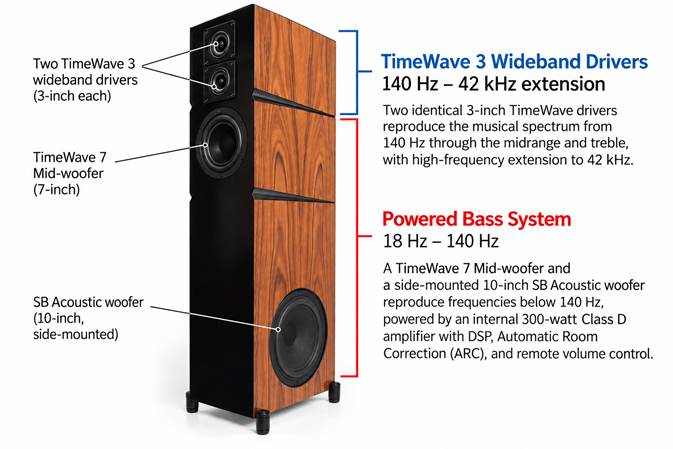
Bellare divides reproduction into two complementary regions: TimeWave 3 wideband reproduction from 140 Hz upward, and an internally powered bass system below 140 Hz.
Why Eliminate the Conventional Midrange-to-Tweeter Crossover?
Most multi-way loudspeakers divide the audible spectrum among several different types and sizes of drivers. Somewhere through the midrange and treble, one driver must stop reproducing the signal while another begins.
That transition requires a crossover network. Even a well-designed crossover can introduce changes in phase, timing, dispersion, and driver radiation patterns through the crossover region.
Bellare takes a different approach. The TW3 drivers reproduce virtually the entire spectrum above 140 Hz. There is therefore no conventional midrange-to-tweeter crossover through the musically critical midrange and treble.
Vocals, harmonics, transients, spatial information, and much of the tonal identity of instruments remain in the hands of the same type of driver. The objective is not simplicity for its own sake. It is to remove a transition that does not need to be there.
What this means when listening: Instead of hearing bass, midrange, and treble as separate regions, Bellare is designed to present music with a continuous character from one frequency range to another. This contributes to tonal continuity, natural transient behavior, and coherence.
The TimeWave 3 Wideband Driver
At the center of Bellare is Audience's 3-inch TimeWave 3 wideband driver, the latest development in a wideband-driver program extending through decades of Audience loudspeaker design.
The TW3 combines a lightweight composite aluminum diaphragm with a die-cast frame, neodymium magnet system, Audience's patented MMAG dual-gap motor structure, and a high-excursion suspension developed through finite-element analysis.
Its relatively short, low-mass voice coil helps minimize inductance and moving mass, contributing to extended high-frequency performance. At the same time, the TW3 provides approximately 6 mm of excursion in each direction—12 mm total—unusually substantial movement for a driver capable of extending into the ultrasonic range.
In Bellare, the TW3 operates from approximately 140 Hz upward, with high-frequency extension to approximately 42 kHz. The significance is not simply bandwidth. Because the same driver technology reproduces such a large portion of the musical spectrum, Bellare avoids handing the signal from a conventional midrange driver to a fundamentally different tweeter.
 |
 |
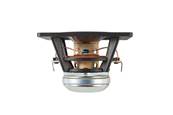 |
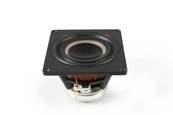
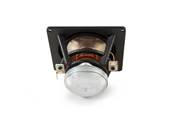
TimeWave 3 wideband driver: front, rear, and side views.
Multiple TW3 Drivers Without Losing Coherence
Using more than one driver over the same frequency range increases output capability and sensitivity, but it also creates another engineering challenge: as frequency rises and wavelengths become shorter, multiple drivers can interfere with one another, producing comb-filtering effects.
Audience addresses this in several ways. The TW3 drivers are mounted extremely close together to minimize path-length differences. Their precision metal mounting plinths allow close spacing with minimal obstruction around the drivers.
In addition, the lower TW3 is progressively low-pass filtered using a copper-foil inductor. As frequency increases, its output is gradually reduced. This reduces the frequency range over which both TW3 drivers operate simultaneously at higher frequencies and thereby reduces comb filtering.
The objective is to gain the output and dynamic advantages of multiple TW3 drivers while preserving the coherent behavior fundamental to the Bellare concept.
Why 140 Hz?
The 140 Hz transition is fundamental to Bellare's architecture. Above this region, the TW3 drivers can operate without being asked to produce the large excursions required for deep bass. Relieving them of that burden reduces excursion demands and allows them to concentrate on the portion of the spectrum where their wide bandwidth, low moving mass, and coherence provide the greatest advantage.
Below 140 Hz, Bellare transfers the job to drivers specifically suited to moving substantially more air: the 7-inch TimeWave 7 mid-woofer and 10-inch SB Acoustics woofer. The two systems therefore complement rather than duplicate one another: the TW3 provides wideband continuity; the powered bass system provides scale, impact, and extension.
Time Coherence: Music Exists in Time
Frequency response tells only part of the loudspeaker story. Music is also an event in time. A drum strike, plucked string, piano hammer, or the beginning of a sung note consists of complex frequency components that must arrive in the correct temporal relationship if the waveform is to retain its natural character.
Conventional multiway systems can introduce timing and phase changes as the signal passes through different crossover sections and physically separated drivers. Bellare minimizes those transitions throughout most of the audible spectrum by allowing its TW3 wideband drivers to reproduce the entire region above approximately 140 Hz. One way of examining this behavior is through a step-response measurement.
Bellare Step Response
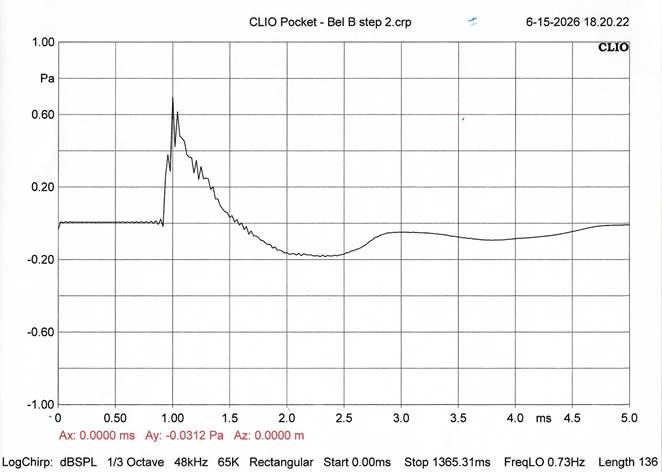
Bellare step response. Measurement taken approximately 18 inches from the front of the loudspeaker, on-axis with the upper TW3 wideband driver.
Bellare's measured step response demonstrates excellent time-domain performance and time coherence. The response reflects one of the fundamental advantages of using wideband drivers to reproduce such a large portion of the musical spectrum.
What this means when listening: Good time-domain behavior contributes to the natural relationship between the beginning, development, and decay of musical sounds. Rather than emphasizing only the leading edge of a transient, Bellare is designed to preserve the complete event.
Full-Range Bass Without Asking the TW3 to Do the Impossible
A small wideband driver can offer exceptional coherence, but asking it to reproduce the lowest octaves at realistic levels introduces compromises in excursion, distortion, dynamic capability, and power handling.
Bellare solves that problem by separating coherence from high-excursion bass reproduction. The TimeWave 7 mid-woofer provides the transition from the TW3 array into the lower frequencies. Its motor, cone, and suspension technology were developed to complement the character of Audience's wideband drivers.
A side-mounted 10-inch SB Acoustics woofer provides the displacement required for the lowest frequencies. Both drivers operate in parallel from the same internal 300-watt Class D DSP amplifier and function together as Bellare's integrated powered bass system.
The objective is not merely deeper bass. It is bass that belongs to the same musical event as everything occurring above it.
Automatic Room Correction: Correcting the Region Where the Room Dominates
At low frequencies, the listening room becomes a major part of what is heard. Room dimensions and speaker/listener placement create peaks and dips that can substantially alter bass response.
Bellare therefore incorporates Automatic Room Correction (ARC) into its powered bass system. Using the supplied calibration microphone, ARC measures the bass response in the listening environment and compares the measured response with a target response. The DSP then generates corrective filtering—including parametric equalization/inverse filtering—to compensate for room-induced response errors.
Each Bellare is measured and calibrated individually, and the resulting correction is stored in that loudspeaker's DSP amplifier. Importantly, ARC is applied to the powered bass system. The TW3 wideband section remains outside the DSP signal path.
This preserves the simplicity of the upper-frequency signal path while applying digital correction where it provides its greatest benefit: the bass region in which the room itself strongly influences response.
Bellare Frequency Response
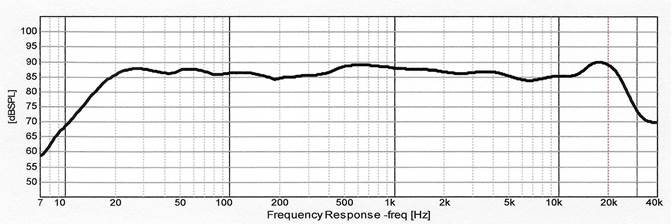
Bellare frequency response measurement. The production Bellare is specified at 18 Hz–22 kHz ±3 dB with ARC, with TW3 high-frequency extension to approximately 42 kHz.
The measurement illustrates something central to the Bellare concept: wideband coherence does not require accepting the limited bass extension historically associated with many single-driver or wideband loudspeaker designs. Bellare combines the two.
What this means when listening: The powered bass system gives Bellare the foundation and scale expected from a large full-range loudspeaker, while the TW3 architecture preserves the continuity and speed that make wideband-driver designs attractive in the first place.
Bellare Changes the Job of the External Amplifier
Bellare's powered bass architecture has another important consequence: the listener's power amplifier does not have to perform the same job it would with a conventional full-range passive loudspeaker.
The customer's amplifier powers the TW3 wideband section. The demanding low-frequency work is handled by Bellare's internal 300-watt amplifier. At low frequencies, Bellare's impedance rises substantially. As impedance rises, the external amplifier is required to deliver less current and power into that region.
This means the external amplifier is relieved of much of the high-current, high-excursion bass workload normally associated with driving a full-range passive loudspeaker. That is why Bellare can work successfully with an unusually broad range of amplifiers—from carefully chosen lower-powered tube designs to considerably more powerful solid-state amplifiers.
Bellare Impedance and Phase
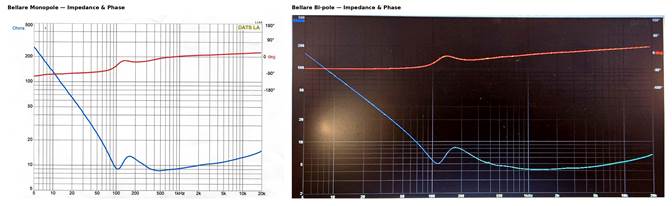
Bellare Monopole and Bi-pole impedance/phase measurements. The Bi-pole plot also shows closely matched left/right loudspeaker measurements superimposed.
The Monopole is nominally 8 ohms, while the Bi-pole is nominally 4 ohms. In the Bi-pole measurement, impedance remains relatively stable through much of the musical spectrum and reaches a minimum of approximately 3.8 ohms around 1 kHz. Below approximately 100 Hz, impedance rises substantially as the customer's amplifier is progressively relieved of the bass workload handled by Bellare's internally powered system.
The relatively uncomplicated impedance behavior also reflects Bellare's simplified architecture and absence of conventional crossover points through the midrange. The closely superimposed left- and right-speaker curves in the Bi-pole measurement demonstrate close matching within the pair, reflecting tight tolerances among the drivers, internal wiring, and passive network components.
What this means for the amplifier: Bellare may reproduce true deep bass, but the customer's amplifier is not being asked to generate all of that bass power. This helps explain why the Bi-pole's 88 dB sensitivity can coexist with successful operation using high-quality amplifiers of relatively modest power.
Monopole and Bi-pole: Two Ways to Energize the Room
Bellare is offered in two configurations because rooms and listening environments differ. The Monopole uses two forward-facing TW3 drivers and is particularly well suited to smaller rooms or installations where the loudspeakers must be positioned closer to the front wall.
The Bi-pole adds two rear-facing TW3 drivers operating in phase with the front pair. This increases sensitivity and dynamic capability while introducing additional energy into the room behind the loudspeaker. In larger rooms, and particularly where Bellare can be positioned several feet from the front wall, the Bi-pole configuration can create an even more expansive and immersive sound field.
The underlying Bellare architecture remains the same in both versions.
A SweetSpace Rather Than a Narrow Sweet Spot
High-end loudspeakers are often evaluated from a single carefully chosen listening position. Bellare was designed to provide a convincing presentation across a broader listening area.
The wideband architecture eliminates the changing radiation patterns associated with a conventional midrange-to-tweeter crossover, while close TW3 spacing helps maintain coherent radiation from the array. In the Bi-pole, the rear TW3 drivers further energize the listening environment.
The result is what Audience calls a SweetSpace rather than simply a sweet spot—a listening area in which tonal balance, spatial information, and the musical presentation remain convincing without requiring the listener's head to remain fixed in one precise position.
Signal Integrity From Input to Driver
Bellare also benefits from an area of engineering experience that long predates the loudspeaker itself. Audience has developed a longstanding reputation in high-performance audio cables, power products, conductors, and passive components. That expertise carries directly into Bellare.
Internal signal wiring uses Audience Auric OCC copper wire, treated both cryogenically and with Audience's EHVP process. The passive network incorporates Audience-designed capacitors, including Auricap XO-PUR-CT capacitors.
Audience's capacitor-design history extends back even further than Audience itself. During the Sidereal Akustic Audio Systems era beginning in the late 1970s, capacitor development produced the SiderealKap, which became known as a high-performance component for audio electronics and loudspeaker networks. That component-development lineage continues in Bellare.
This matters because Bellare's philosophy is fundamentally about removing unnecessary obstacles between the amplifier and the music. Eliminating a conventional midrange-to-tweeter crossover is part of that objective; careful attention to the conductors and passive components that remain in the signal path is another.
Designed as a Complete System
No single technology explains Bellare. Its performance results from the interaction of several deliberately complementary ideas:
- TW3 wideband reproduction above 140 Hz, eliminating the conventional midrange-to-tweeter crossover.
- Progressive low-pass filtering of the lower TW3 to reduce comb filtering.
- A TimeWave 7 mid-woofer and 10-inch SB Acoustics woofer providing high-excursion bass.
- A dedicated 300-watt DSP amplifier relieving the external amplifier of the principal bass workload.
- Automatic Room Correction applied where the listening room has its greatest influence.
- Carefully controlled passive components and Audience Auric OCC internal wiring.
- Monopole and Bi-pole configurations allowing Bellare to adapt to different rooms and placement requirements.
Remove what gets in the way of the music.
Engineering as a Means, Not the Goal
Bellare contains sophisticated engineering, but complexity itself was never the objective.
The objective was to preserve the qualities that have made wideband loudspeakers compelling for generations—continuity, immediacy, speed, and coherence—while overcoming their traditional limitations in bass extension, output capability, dynamics, and room integration.
That is why Bellare combines a remarkably simple idea above 140 Hz with sophisticated technology below it.
Wideband coherence without sacrificing full-range performance.
ClairAudient Bellare — The Evolution of a Wideband Idea, 50 Years in the Making
The Bellare did not begin as a single loudspeaker project.
It is the culmination of a pursuit extending back nearly five decades: to reproduce music while eliminating as many of the discontinuities and compromises of conventional multiway loudspeaker design as possible.
At the center of that pursuit has always been one fundamental idea:
Preserve the musical signal by removing what gets in its way.
The Beginning: Ted Jordan and the Wideband Ideal
The roots of Bellare's design philosophy reach back to the work of British loudspeaker pioneer E. J. “Ted” Jordan, whose research and writing explored the advantages of reproducing as much of the musical spectrum as possible with a single wideband transducer.
Jordan's philosophy, documented in The Jordan Manual, made a lasting impression on John McDonald.
The appeal was fundamental. Conventional loudspeakers divide music among woofers, midrange drivers, and tweeters. Crossover networks determine where one driver stops and another begins.
But music does not arrive divided into frequency bands.
A wideband driver offers another possibility: allow the same radiating element to reproduce the fundamentals and harmonics of voices and instruments over an exceptionally broad frequency range, reducing the transitions that can affect phase, timing, dispersion, and tonal continuity.
That idea would ultimately become central to Audience loudspeaker design.
Sidereal Akustic Audio Systems — 1979
John McDonald met designer and audiophile Richard Smith in Southern California in 1972. Their shared interest in music and its reproduction eventually led to the formation of Sidereal Akustic Audio Systems (SAAS) in 1979.
McDonald served as vice president and Smith as president.
SAAS became the exclusive U.S. importer of Ted Jordan's British-made Jordan Module wideband drivers. More importantly, the company provided McDonald and Smith with an opportunity to explore the possibilities of wideband loudspeaker design firsthand.
The experience established principles that would resurface decades later in Bellare: broad-bandwidth drivers, attention to phase and timing, and the desire to minimize crossover networks through the musically critical portion of the spectrum.
SAAS ceased operation in 1985, but the underlying idea did not disappear.
Audience — Returning to the Original Vision
In 1997, John McDonald and Richard Smith came together again, joined by design engineer Roger Sheker, to establish Audience.
Although Audience would become famously known for cables, power conditioning, capacitors, and other high-performance audio products, loudspeakers were central to the company's original purpose.
The goal was ambitious: create a loudspeaker capable of preserving the coherence and immediacy of a wideband design without imposing the conventional woofer/midrange/tweeter architecture and its multiple crossover transitions.
Audience initially worked with commercially available Bandor wideband drivers from the United Kingdom.
For years, McDonald and Smith pursued the concept of using the best drivers available to them.
Then Roger Sheker changed everything.
Roger Sheker and the Audience A3
Sheker believed Audience could design a better wideband driver of its own.
John McDonald was initially skeptical. Developing a proprietary driver capable of exceeding the best available wideband units was an enormous undertaking.
Sheker persisted.
The result was the Audience A3, a proprietary 3-inch wideband driver that transformed the company's loudspeaker program.
Rather than adapting an existing commercial driver to Audience's philosophy, Audience could now develop the transducer and loudspeaker together as a system.
The A3 became the technological foundation upon which subsequent generations of Audience wideband drivers would be built.
Years of further development followed.
The ClairAudient Loudspeaker Family
In 2009, Audience introduced the ClairAudient 16, bringing its long-running wideband-driver project to the commercial market on a new scale.
Other ClairAudient models followed, using variations and later generations of Audience's proprietary 3-inch wideband driver technology.
The concept remained remarkably consistent: using identical wideband drivers over as much of the musical spectrum as possible and avoid conventional crossover transitions through the midrange and high frequencies.
As the technology evolved, so did the drivers.
The original A3 led to the A3S, subsequent refinements, and eventually the advanced Audience wideband drivers used in later ClairAudient designs.
Each generation provided another opportunity to improve excursion, bandwidth, power handling, distortion, and dynamic capability without abandoning the underlying wideband philosophy.
ClairAudient 1+1 V5 — The Immediate Predecessor to Bellare
One of the most important steps toward Bellare was the highly acclaimed ClairAudient 1+1 V5 Personal Reference Monitor.
Its compact dimensions disguised what Audience considered reference-level qualities of coherence, transparency, speed, and spatial realism.
The 1+1 demonstrated how much musical information could be preserved when identical wideband drivers reproduced nearly the entire musical spectrum without a conventional midrange-to-tweeter crossover.
When partnered with high-quality subwoofers, the 1+1 also demonstrated something else: wideband coherence did not necessarily have to be confined to a small-scale listening experience.
That observation helped lead to the question that eventually became Bellare:
Could the coherence of Audience's best compact wideband loudspeakers be combined with true full-range bass, realistic dynamics, greater scale, and substantially higher output in a single integrated system?
The Bellare Challenge
Traditional wideband and single-driver loudspeakers offer an obvious attraction: one transducer can reproduce a large portion of the musical spectrum without handing the signal from one type of driver to another.
But the approach also creates challenges.
Deep bass requires substantial cone excursion and displacement. Asking the same small, lightweight driver that reproduces delicate midrange and high-frequency information to simultaneously reproduce the lowest octaves places competing demands upon it.
Audience approached Bellare by separating those jobs.
Rather than asking the wideband driver to do everything, Bellare would allow it to do what it does best.
The demanding work of reproducing deep bass would be assigned to a purpose-designed, internally powered bass system.
From A3 to TimeWave
Bellare introduced the latest evolution of Audience's wideband-driver development: the TimeWave 3 (TW3).
The TW3 preserves the basic concept that began with Audience's earliest proprietary 3-inch drivers while incorporating decades of accumulated development in motor design, diaphragm construction, suspension, excursion capability, and bandwidth.
In Bellare, the TW3 array operates from approximately 140 Hz through the audible high-frequency range, with extension to approximately 42 kHz.
Audience also developed the 7-inch TimeWave 7 (TW7) to provide a complementary transition between the TW3 array and the deep-bass woofer.
During Bellare's development, testing showed that using the TW7 in addition to the 10-inch woofer produced a more natural transition than asking the 10-inch driver alone to bridge the entire region between deep bass and the TW3 array.
The resulting architecture allows each driver system to operate where its characteristics are best suited.
Adding Full-Range Bass Without Giving Up Coherence
Each Bellare incorporates a TimeWave 7 mid-woofer and 10-inch high-excursion woofer powered by its own 300-watt DSP amplifier.
Automatic Room Correction allows the bass system to be optimized for the acoustic behavior of the individual listening room.
This architecture also changes the demands placed upon the listener's external amplifier. Bellare's internal amplifier supplies the substantial power required for deep bass, while the external amplifier concentrates primarily on driving the TW3 wideband array.
The result is a loudspeaker capable of deep bass, large-scale dynamics, and high output while preserving the wideband architecture that inspired the project in the first place.
A Philosophy That Has Remained Consistent
Richard Smith summarized the philosophy years before Bellare existed.
In a 2006 interview with Jim Merod, Smith described the objective as removing what stands between the listener and the music. Speaking specifically about crossover networks, he expressed Audience's longstanding preference in its simplest form:
“The best crossover network is none at all.”
Bellare does contain crossover filtering where engineering requires it. Its TW3 array is high-pass filtered at approximately 140 Hz, while the internally powered bass system uses active low-pass filtering.
What Bellare avoids is the conventional midrange-to-tweeter crossover through the heart of the musical spectrum.
The implementation has evolved dramatically since the earliest Audience experiments.
The philosophy has not.
A Longstanding Pursuit of Musical Coherence
Over the years, independent listeners have repeatedly responded to the qualities Audience has pursued through its wideband approach.
Earlier ClairAudient designs earned attention for coherence, openness, sound staging, and their ability to convey the musical event without drawing attention to the loudspeaker itself. Contemporary coverage of the ClairAudient family similarly identified coherence as a defining consequence of Audience's approach.
Bellare carries that lineage into a substantially more ambitious full-range system.
Today's reviewers have independently described many of the same fundamental qualities—continuity, naturalness, disappearance of the loudspeakers as apparent sound sources, realistic instrumental texture, spatial dimensionality, and an unusual sense of musical coherence.
Different loudspeakers. Different generations of technology.
The objective remains remarkably consistent.
Bellare — The Culmination
The path to Bellare can be traced through nearly five decades of ideas and development:
Ted Jordan → Sidereal Akustic Audio Systems → Richard Smith and John McDonald → Audience → Roger Sheker and the A3 → A3S → ClairAudient → 1+1 V5 → TimeWave → Bellare
Bellare is therefore more than a new floor standing loudspeaker.
It represents Audience's attempt to resolve a challenge that has been present since the beginning of the company's loudspeaker work:
How can the coherence of a wideband loudspeaker be preserved while overcoming the limitations traditionally associated with wideband and single-driver designs?
Bellare is Audience's answer:
Wideband coherence without sacrificing full-range performance.
ClairAudient Bellare — Questions & Answers
What is the Audience ClairAudient Bellare?
The ClairAudient Bellare is Audience's full-range floor standing loudspeaker system designed around the company's wideband-driver philosophy.
Rather than dividing the musically critical spectrum among conventional woofer, midrange, and tweeter drivers, Bellare uses Audience TimeWave 3 (TW3) wideband drivers to reproduce frequencies from approximately 140 Hz through and beyond the audible high-frequency range.
Below approximately 140 Hz, a dedicated 7-inch TimeWave 7 mid-woofer and 10-inch woofer, powered by an internal 300-watt DSP amplifier, provide deep bass and integrate the loudspeaker with the listening room through Automatic Room Correction (ARC).
The objective is wideband coherence without sacrificing full-range performance.
Why doesn't Bellare use a conventional tweeter?
Audience believes that dividing the upper musical spectrum between a midrange driver and a separate tweeter introduces an unnecessary transition through frequencies where human hearing is particularly sensitive.
Bellare takes a different approach. Its 3-inch TimeWave 3 wideband drivers reproduce frequencies from approximately 140 Hz through the audible high-frequency range, with extension to approximately 42 kHz.
Because the same type of driver reproduces this exceptionally broad range, Bellare eliminates the conventional midrange-to-tweeter handoff and the accompanying change in driver size, construction, dispersion, and crossover behavior.
Does Bellare have a crossover?
Yes, but not a conventional midrange-to-tweeter crossover.
Bellare's TW3 wideband array uses a passive second-order high-pass network at approximately 140 Hz. The internally powered bass system uses active DSP-controlled low-pass filtering to integrate the TimeWave 7 mid-woofer and 10-inch woofer with the TW3 array.
Above approximately 140 Hz, there is no conventional crossover from a midrange driver to a separate tweeter.
This distinction is important: describing Bellare simply as a “crossover less” loudspeaker would not be technically accurate.
Why is eliminating the midrange-to-tweeter crossover important?
A conventional crossover divides the musical signal between different drivers. Around the crossover frequency, both drivers contribute simultaneously while their amplitude, phase, dispersion, and timing characteristics interact.
Bellare substantially avoids these interactions through the critical midrange and high-frequency region by allowing its TW3 wideband drivers to reproduce that entire range.
The goal is greater continuity in timing, phase, tonal character, transient behavior, and spatial information.
What is the Audience TimeWave 3 driver?
The TimeWave 3, or TW3, is Audience's proprietary 3-inch wideband driver and the latest evolution of decades of Audience wideband-driver development.
It incorporates a composite aluminum diaphragm, neodymium magnet system, Audience MMAG dual-gap motor technology, a high-excursion suspension, and a low-mass moving system.
The TW3 provides approximately 6 mm of excursion in each direction—12 mm total—and is designed to combine wide bandwidth, low moving mass, transient speed, and substantial dynamic capability.
In Bellare, the TW3 operates from approximately 140 Hz through the audible high-frequency spectrum, with extension to approximately 42 kHz.
What is the difference between Bellare Monopole and Bellare Bi-pole?
The Bellare Monopole uses two front-firing TW3 wideband drivers per loudspeaker.
The Bellare Bi-pole uses two front-firing and two rear-firing TW3 drivers per loudspeaker. The front and rear drivers operate in phase.
The Monopole is particularly well suited to smaller rooms or installations where the loudspeakers need to be positioned relatively close to the front wall.
The Bi-pole is intended for rooms where the loudspeakers can be positioned farther into the room. Its additional rear radiation increases sensitivity and dynamic capability while contributing to a larger, more immersive sound field.
Why does Audience call it “Bi-pole”?
Audience uses Bi-pole to describe the Bellare configuration because the front- and rear-firing TW3 drivers operate in phase.
This distinguishes the design from a dipole arrangement, in which front and rear radiation operate with opposite polarity.
What is Bellare's SweetSpace?
Audience uses the term SweetSpace to describe a listening area in which stable imaging, tonal balance, and a convincing sound field can be enjoyed over a broader area than the narrowly defined “sweet spot” associated with many high-performance loudspeakers.
Bellare's wideband architecture and uniform polar behavior help maintain a believable presentation across the listening area.
The result is particularly valuable when several people are listening together: enjoying the musical presentation does not depend upon everyone occupying one precisely defined central seat.
How does Bellare reproduce deep bass if its TW3 drivers only operate down to approximately 140 Hz?
Bellare deliberately separates the reproduction of deep bass from the wideband driver's job.
Each loudspeaker incorporates an Audience TimeWave 7 7-inch high-excursion mid-woofer and a 10-inch high-excursion woofer. These are powered by a dedicated internal 300-watt DSP amplifier.
This provides the power and displacement required for deep bass while relieving the TW3 drivers of the large excursions that low-frequency reproduction would otherwise require.
Bellare is specified to reproduce 18 Hz–22 kHz ±3 dB with ARC calibration.
Why use both a 7-inch mid-woofer and a 10-inch woofer?
During Bellare's development, Audience found that adding the 7-inch TimeWave 7 between the TW3 array and the deep-bass woofer produced a more natural transition than relying upon the 10-inch woofer alone.
The TW7 was developed using related Audience driver technology and provides the excursion and output required in the upper-bass/lower-midrange transition region while helping maintain continuity with the TW3 wideband drivers.
The 10-inch woofer can therefore concentrate on the deepest frequencies where greater cone area and displacement are required.
What does Bellare's Automatic Room Correction do?
Bellare's Automatic Room Correction, or ARC, optimizes the internally powered bass system for the acoustic behavior of the listening room.
A calibrated microphone supplied with Bellare measures each loudspeaker independently. The DSP system analyzes the measured low-frequency response and applies corrective equalization to the bass system.
Each loudspeaker stores its own calibration.
ARC is intentionally applied where room interaction is greatest—the bass region—while the externally amplified TW3 wideband array remains outside the DSP signal path.
Does ARC process the midrange and high frequencies?
No.
ARC operates on Bellare's internally powered bass system. The TW3 wideband array is driven by the listener's external amplifier through Bellare's passive network.
This allows DSP room correction to address the frequencies where the room has its greatest influence without digitally processing Bellare's wideband midrange and high-frequency signal.
Why are Bellare's 10-inch woofers positioned on the inside?
Bellare is designed with the side-mounted woofers facing inward toward one another.
At these low frequencies, bringing the woofers physically closer together encourages acoustic coupling between the two bass sources and helps the system behave as a more unified low-frequency source.
ARC then optimizes the bass response for the particular room, while bass level can be fine-tuned independently.
Why can Bellare work with relatively low-powered amplifiers?
Bellare divides amplification responsibilities differently from a conventional passive full-range loudspeaker.
The external amplifier drives the TW3 wideband array. Below approximately 140 Hz, the external amplifier sees rising impedance, reducing the low-frequency current and power it must supply.
Bellare's internal 300-watt DSP amplifier provides the power required by the bass system.
Consequently, the listener's amplifier is relieved of much of the demanding deep-bass workload normally associated with a full-range loudspeaker.
As a general recommendation, Audience recommends a high-quality amplifier capable of at least 30 watts continuous output. Depending upon amplifier quality, however, excellent results may be obtained with as little as 10 watts into the 4-ohm Bellare Bi-pole or 20 watts into the 8-ohm Bellare Monopole. Higher-powered amplifiers are also fully compatible.
Are tube amplifiers suitable for Bellare?
Yes. Bellare's architecture makes it compatible with a broad range of high-quality tube and solid-state amplifiers.
Because Bellare's internal amplifier supplies the demanding bass power, the external amplifier can be selected more for its sonic and musical qualities rather than solely for high power output.
As with any loudspeaker/amplifier combination, amplifier quality and compatibility remain important.
What are the impedance and sensitivity of the two Bellare versions?
The Bellare Monopole has a nominal impedance of 8 ohms and a sensitivity of 86 dB (1 W/1 m).
The Bellare Bi-pole has a nominal impedance of 4 ohms and a sensitivity of 88 dB (1 W/1 m).
Because Bellare's internal amplifier powers the bass system, these sensitivity figures alone do not fully describe the relatively easy load Bellare presents to an external amplifier.
Is Bellare a point-source loudspeaker?
Bellare uses closely spaced identical TW3 wideband drivers rather than separate midrange and tweeter sources.
The drivers are positioned as closely together as practical to minimize path-length differences and interaction between the multiple radiating surfaces.
Rather than relying on physically separated, dissimilar drivers through the critical midrange and high-frequency spectrum, Bellare's array behaves as a highly coherent wideband source.
How does Bellare minimize interaction between multiple TW3 drivers?
Any loudspeaker using multiple drivers over the same frequency range must address acoustic interaction between them.
Audience places Bellare's TW3 drivers very close together to minimize path-length differences. A precision thin metal mounting plinth also allows the drivers to be positioned closer together than would be practical with a thick conventional wooden baffle.
In addition, a custom flat-wound copper-foil air-core inductor gently attenuates the upper frequencies of the lower TW3 driver, reducing overlap in the frequency region where interaction would otherwise become most significant.
What does time coherence mean in a loudspeaker?
Music exists in time as well as frequency.
A loudspeaker must reproduce not only the correct frequencies but also the timing relationships among transients, fundamentals, harmonics, and spatial information.
Conventional multiway systems can introduce changes in phase and arrival time as the signal passes through crossover networks and different drivers.
Bellare's wideband architecture substantially reduces these transitions through the critical musical spectrum. Its measured step response provides useful evidence of the system's time-domain behavior.
How loud can Bellare play?
Bellare was designed to retain the speed and coherence associated with wideband loudspeakers while overcoming the limited output and dynamic capability commonly associated with traditional single-driver designs.
Bellare is specified for approximately 105 dB continuous output without driver compression, allowing it to reproduce demanding music at realistic levels while maintaining composure.
What makes Bellare different from a traditional single-driver loudspeaker?
Traditional single-driver loudspeakers can offer exceptional coherence because one driver reproduces most or all of the musical spectrum. Their compromises can include limited highest frequencies and deep bass, restricted output capability, high excursion demands, and limited dynamics.
Bellare preserves the central advantage of the wideband approach while assigning deep bass to a purpose-designed, internally powered bass system.
The result is the concept at the heart of Bellare:
Wideband coherence without sacrificing full-range performance.
Audience ClairAudient Bellare Loudspeaker System
Owner's Manual
Dear Valued Audience Customer,
Congratulations on your purchase of the Audience ClairAudient Bellare loudspeaker system.
Bellare represents decades of Audience loudspeaker development, combining our wideband timewave driver technology with an internally powered bass system, DSP control, and Automatic Room Correction (ARC).
This manual will guide you through unpacking, positioning, installation, amplifier connection, ARC calibration, and final adjustment of your Bellare loudspeakers.
We encourage you to read these instructions completely before beginning installation.
Thank you for choosing Audience. We hope your Bellare loudspeakers provide many years of exceptional musical enjoyment.
The Audience Team
- Before You Begin
The Bellare loudspeakers are substantial in size and weight. We recommend moving each shipping carton close to the approximate final location of the speaker before beginning the unboxing process.
Do not attempt to lift the loudspeaker vertically out of a carton lying on the floor. The recommended procedure allows the Bellare to remain upright and slide from its carton.
When handling the loudspeaker, keep your hands near the lower portion of the cabinet to maintain a low center of gravity.
Take particular care not to touch or place pressure on any of the driver units.
Whenever practical, retain all original cartons, foam inserts, protective covers, and other packing materials. The original packaging provides the safest means of protecting the Bellare should the loudspeakers ever need to be transported.
- Included Accessories
Accessories are packed within both Bellare cartons.
The paperwork, ARC setup instructions, calibrated microphone, microphone cable, remote control, microphone stand, and one Audience forte f3 powerChord are located in the top foam insert of one speaker carton.
The second Audience forte f3 powerChord is packed in the other carton.
A soft microfiber cloth is also supplied for removing fingerprints or smudges that may occur while unpacking and positioning the loudspeakers.
Please examine both cartons and all compartments within the foam packaging carefully before discarding or storing the packing material.
After both speakers have been unpacked, compare all included items with the supplied accessory checklist.
- Unpacking the Bellare
Move each carton close to the approximate location where its loudspeaker will be installed.
Stand the carton upright and open it.
The grille covers are positioned alongside the loudspeaker cabinet and protected with bubble wrap. Carefully remove the grilles and place them in a safe location.
With the loudspeaker remaining upright, carefully slide it from the carton. This is considerably easier and safer than attempting to lift the speaker from a carton lying horizontally.
Hold the cabinet near its lower portion while moving it and avoid contact with the drivers.
Once the loudspeaker has been slid from the carton, remove the top and side foam inserts.
Cut the tape securing the lower foam sections. Gently lean the loudspeaker slightly to one side and remove the first section of bottom foam. Then lean the speaker slightly in the opposite direction and remove the remaining section.
Carefully remove the protective cloth cover.
Repeat the procedure for the second loudspeaker.
Inspect both loudspeakers and verify the contents with the supplied checklist before proceeding with installation.
- Caring for the Finish
The Bellare's high-quality finish should be treated with appropriate care.
A soft microfiber cloth is included for gently removing fingerprints or smudges from the cabinet.
For small superficial surface scratches that may occur from time to time, Audience recommends Adam's Scratch & Swirl Remover. Apply any polishing product carefully and conservatively, following the product manufacturer's instructions.
Never allow cleaning or polishing products to come in contact with the loudspeaker drivers.
Avoid placing objects on top of the loudspeaker cabinet that could scratch or otherwise damage the finish.
- Adjusting the Stillpoints Isolation footers
Each isolator has a threaded stud corresponding to a threaded receptacle in the Bellare footer bracket.
Adjust their individual heights by rotating them inward or outward until the loudspeaker is both level and completely stable. Leave both body and cap of the Stillpoints, loose by 1/2 to 1 whole turn. Do not leave either piece tightened snugly.
The loudspeaker should not rock when gently tested for stability.
Repeat this procedure for the second Bellare.
- Initial Loudspeaker Positioning
Bellare loudspeakers can be positioned using the same basic principles as other high-performance loudspeaker systems, followed by fine placement adjustments.
As a starting point in a typical listening room, position the two loudspeakers approximately 6 to 10 feet apart.
Room dimensions and acoustics may require different spacing. Smaller or particularly large rooms may benefit from positioning outside this suggested starting range.
Position the Bellare loudspeakers with the side-mounted woofers facing inward, toward one another.
Begin with the speakers toed in toward the primary listening position so that the loudspeaker axes point approximately toward the listener's ears from the center seating position.
When seated in the primary listening position, very little of the sides of the cabinets should be visible.
This should be considered a starting position rather than an absolute requirement. Final positioning and toe-in can be adjusted by listening after the system has been connected and ARC calibration has been completed.
Grilles
Use of the Bellare grilles is optional.
For optimum sonic performance, Audience recommends listening with the grilles removed. Leaving the grilles installed may result in a slight reduction in ultimate sound quality.
- External Amplifier Requirements
Bellare incorporates its own 300-watt DSP bass amplifier, but an external stereo amplifier or pair of monaural amplifiers is required to drive the 3-inch wideband timewave drivers.
Bellare is designed to be compatible with a broad range of high-quality amplifiers.
The Bellare Monopole version presents a nominal 8-ohm impedance, while the Bellare Bi-pole version presents a nominal 4-ohm impedance.
As a general recommendation, a high-quality amplifier capable of at least 30 watts continuous output will work very well with the system. However, depending on the quality of the amplifier sometimes as little as 10 watts into 4 ohms (Bellare Bi-pole) or 20 watts into 8 ohms (Bellare mono-pole) can perform very well. Naturally, higher output amplifiers are also very compatible.
One reason Bellare can be used successfully with relatively modest-power external amplifiers is its unusual division of amplification responsibilities.
Below approximately 140 Hz, the external amplifier sees a rising impedance, reducing the amount of low-frequency current and power it must provide. The Bellare's internal 300-watt DSP amplifier supplies the power required by the bass system.
The external amplifier is therefore relieved of much of the demanding low-frequency workload normally imposed by a full-range passive loudspeaker.
This architecture allows Bellare to combine moderate sensitivity with compatibility with a wide range of high-quality amplifiers.
- Connecting the External Amplifier
Turn off the associated equipment before making speaker connections.
The user's external amplifier connects directly to the Bellare's speaker input terminals.
Bellare uses standard 5-way binding posts:
Red = Positive (+)
Black = Negative (–)
Observe correct polarity when connecting both loudspeakers.
Connect the positive output terminal of the external amplifier to the red positive terminal on the corresponding Bellare. Connect the negative amplifier terminal to the Bellare's black negative terminal.
Repeat for the second channel.
Bellare is internally wired so that the external amplifier's signal also provides the input signal to the internal DSP bass amplifier. Consequently, no additional line-level signal connection to the internal bass amplifier is required.
- Connecting AC Power
Each Bellare contains its own DSP-controlled bass amplifier and therefore requires connection to AC power.
Connect one of the supplied Audience forte f3 powerChords to each Bellare and then to an appropriate AC power outlet.
After the external amplifier(s) has been properly connected to the loudspeakers and the Bellare internal amplifiers have been connected to AC power, the internal DSP amplifiers can be switched on with the on/off switch on the back of the speaker.
The system is now ready for ARC calibration.
- Automatic Room Correction (ARC)
Bellare incorporates Automatic Room Correction to optimize low-frequency performance for the acoustic characteristics of the listening room.
A calibrated measurement microphone, microphone cable, and microphone stand are supplied with the system.
ARC calibration should be performed after the loudspeakers have been placed in their intended listening positions.
Important
ARC calibration must be performed separately for each Bellare loudspeaker.
Each Bellare contains its own DSP-controlled bass amplifier and stores its own individual ARC calibration.
Complete the entire calibration procedure for the first loudspeaker before repositioning the microphone and repeating the process for the second loudspeaker.
Once ARC calibration has been completed, the calibration is retained by the system and does not need to be repeated simply because the internal DSP amplifier has been switched off.
ARC should be recalibrated if a loudspeaker is moved significantly or if its acoustic environment is substantially changed.
- ARC Preparation
Begin with the first Bellare to be calibrated.
- Position both Bellare loudspeakers in their intended listening locations with the side-mounted woofers facing inward toward one another.
- Turn on the internal bass amplifier of the Bellare being calibrated.
- Set the Amplifier Auto/On selector to ON.
Do not use the Auto-On setting.
- Establish the following initial amplifier control settings:
Volume: 12 o'clock
Crossover: 3 o'clock
Phase: 0 degrees
- Place the supplied calibrated microphone securely in its stand.
- Position the microphone on the floor with the microphone pointed directly toward the ceiling.
- Position the microphone one meterfrom the axis of the side-mounted woofer of the Bellare being calibrated.
- Connect the microphone to that Bellare's internal amplifier, at the mic input designated on the amplifier on the back of the speaker.
- Make the listening room as quiet as reasonably possible. Turn off HVAC equipment, ceiling fans, and other significant sources of ambient noise.
The first Bellare is now ready for ARC calibration.
- ARC Calibration Procedure
Step 1 — Select Calibration Mode on the amplifier on the rear of the speaker.
Press the ARC Preset button until CAL (Calibration) mode is selected.
The blue indicator light should illuminate, confirming that calibration mode is active.
Step 2 — Begin the Scan
Press and hold the ARC Preset button until the audio-frequency scan begins. This requires approximately five seconds.
Step 3 — Allow Calibration to Complete
Allow the complete scan to run without interruption.
Calibration may take up to approximately two minutes.
Avoid talking, walking near the microphone, or introducing unnecessary noise while the measurement is taking place.
Step 4 — Select Music Mode
When calibration is complete, press the ARC Preset button repeatedly until the red MUSIC mode is selected.
Do not use Movie mode for normal Bellare operation.
Step 5 — Disconnect the Microphone
Disconnect the calibration microphone from the first Bellare.
The ARC calibration for the first loudspeaker is now complete.
- Calibrating the Second Bellare
Move the microphone to the corresponding position one meter from the axis of the second Bellare's side-mounted woofer.
Again, the microphone should be positioned on the floor in its stand and pointed directly toward the ceiling.
Connect the microphone to the second Bellare.
Confirm that the second speaker's controls are set to the same initial positions:
Volume: 12 o'clock
Crossover: 3 o'clock
Phase: 0 degrees
Amplifier: ON, not Auto-On
Repeat the complete ARC calibration procedure described in the previous section.
When calibration has been completed, select the red MUSIC mode and disconnect the microphone.
Both Bellare loudspeakers are now individually calibrated for the room and ready for final listening adjustment.
- Final Listening Adjustment
After ARC calibration has been completed for both loudspeakers, allow the system to play familiar music and make any final positioning or level adjustments by ear.
Begin with the Bellare loudspeakers in the recommended starting position of 12: O’clock for the volume control and with the side-mounted woofers facing inward toward each other.
Small changes in speaker spacing, distance from the front wall, and toe-in can significantly affect soundstage width, image focus, tonal balance, and overall integration with the room.
If desired, make these adjustments gradually while listening from the primary seating position.
The bass level may also be fine-tuned using the supplied remote control.
Make only small adjustments at a time. The objective is not to create exaggerated bass, but to achieve a natural low-frequency balance that integrates seamlessly with the wideband drivers.
Once the preferred positioning and bass level have been established, no further routine adjustment should be necessary.
If either loudspeaker is moved substantially, or if the room arrangement changes significantly, Audience recommends repeating the ARC calibration procedure.
- Normal Operation
For normal listening, the internal DSP bass amplifiers should remain in MUSIC mode.
Use the Bellare loudspeakers as you would any high-quality loudspeaker system, with your external amplifier providing power to the wideband driver array and the Bellare's internal amplifiers powering the bass system.
The internal ARC calibration remains stored when the system is switched off and does not need to be repeated each time the loudspeakers are powered on.
The Bellare may be left connected to AC power during normal use. If the system will not be used for an extended period, or during severe electrical storms, Audience recommends switching off and disconnecting the loudspeakers from AC power.
Always reduce system volume before switching associated components on or off.
Avoid operating the loudspeakers at levels where the external amplifier is audibly clipping or producing obvious distortion.
- Care and Maintenance
The Bellare loudspeaker system requires no routine internal maintenance.
Keep the cabinet surfaces clean using the supplied microfiber cloth or another soft, non-abrasive cloth.
Do not use household cleaners, solvents, abrasive compounds, or excessive moisture on the cabinet.
Never apply cleaning products directly to the loudspeaker drivers.
Also inspect speaker-cable connections and AC power connections periodically to ensure that they remain secure.
If the loudspeakers are to be moved or shipped, Audience strongly recommends using the original cartons, foam inserts, protective covers, and packing materials.
- If You Need Assistance
If you have trouble with installation, ARC calibration, system setup, or operation, please contact your authorized Audience dealer or Audience directly.
When requesting assistance, please provide the Bellare model, serial numbers, associated amplifier and system information, and a brief description of the issue.
Audience and its authorized dealers will be pleased to assist with setup, system matching, and optimization.
Audience
760-471-0202
info@audience-av.com
www.audience-av.com
