
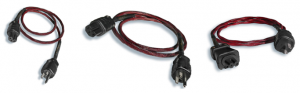
San Marcos, CA, March 10, 2014 – Audience today announced the introduction of its Au24 SE MP (medium power), Au24 SE LP (low power) and Au24 SE c7 powerChord AC line cords,three different-sized, lower-cost versions of Audience’s currently available Au24 SE powerChord.
The Au24 SE MP, Au24 SE LP and Au24 SE c7 are designed to best suit the demands of components like preamps, CD players and D/A converters that require lesser amounts of AC power compared to larger amplifiers and other components that draw more power. Along with providing optimum performance, the new models offer significant savings over the cost of the original Au24 SE powerChord.
The Au24 SE MP powerChord features 14 AWG wiring and is recommended for use with components that require up to 150 watts of AC power. The Au24 SE LP employs 16 AWG wiring and should be used with components that require up to 50 watts. The Au24 SE c7 is also 16 AWG and fits into the c7 AC connector used on some audio/video components.
The MP, LP and c7 models all provide the same level of performance, when used as prescribed, as the standard Au24 SE, which utilizes 10 AWG wiring and is ideal for use with amplifiers and components that have high power demands. As an added benefit, these powerChords are exceptionally flexible for ease of use.
All Au24 SE powerChords are designed to eliminate or reduce the traditional weak points of conventional power cords: more often than not, power cords will behave in a reactive manner and
introduce capacitance, inductance and resistance into the electron flow, which will compromise the interface between the component and the power source.
“Can a power cord really make that significant of a difference? Rather than looking at a power cord as the last few feet in a long line of power delivery, consider the power cord as the first few
feet of your component’s primary transformer winding,” noted John McDonald, president of Audience. “Viewed this way, a high quality, well designed power cord is an essential part of preserving
the performance of your music or audio/video system.”
Audience Au24 SE powerChords feature a high-current, low impedance, wide bandwidth design for fast response, accurate reproduction of macro and micro dynamics, articulate bass, superior
imaging, exceptional harmonic integrity, lower background noise and additional benefits. Au24 SE powerChords are constructed using the highest quality materials including OHNO high-purity
monocrystal copper wiring, rhodium-plated copper plugs and IEC connectors and are available in both US and European (Schuko) styles.
Audience Au24 SE MP, Au24 SE LP and Au24 SE C7 powerChords are available now with suggested retail pricing as follows: Au24 SE MP, $1,250 @ 6 ft, +/- $75 per foot; Au24 SE LP, $1,080 @ 6 ft, +/- $50 per foot, Au24 SE c7, $799 @ 6 ft, +/- $35 per foot.
# # #
About Audience
Audience was formed in November 1997 by John McDonald and the late Richard Smith, as a design and production company focused on building the best possible audio and video equipment. To pass the Audience test, each product must truly make a significant contribution to the reproduction of audio and/or video. Audience offers loudspeakers, electronics, cables, power conditioners, high-resolution capacitors and the Auric Illuminator optical disk resolution enhancement.
Audience’s commitment is to develop the very best products possible, and the company is committed to unexcelled customer service and product support. All Audience cables have an unconditional lifetime warranty and power conditioners have a ten-year warranty. For more information visit www.audience-av.com.